Requesting a quotation for steel castings involves more than sharing a drawing and asking for a price. Whether you are sourcing industrial pump casings, valve bodies, heavy machinery components, or custom-engineered castings, the accuracy of your quotation depends on the technical information you provide to the manufacturer.
An incomplete Request for Quotation (RFQ) can lead to incorrect cost estimates, unexpected tooling expenses, manufacturing delays, and confusion over inspection requirements.
For example, two casting manufacturers may provide significantly different prices for the same component because one quotation includes CNC machining, heat treatment, and non-destructive testing, while the other covers only the raw casting.
A well-prepared steel casting RFQ checklist helps eliminate these differences by ensuring that manufacturers receive clear and consistent technical requirements.
From engineering drawings and ASTM material grades to machining tolerances, testing requirements, production quantities, and delivery conditions, each detail influences the manufacturing process and final quotation.
In this guide, we explain what buyers, OEMs, procurement teams, and project engineers should include when requesting a steel casting quotation.
What Is a Steel Casting RFQ?
A Steel Casting Request for Quotation (RFQ) is a technical and commercial document shared with a foundry or casting manufacturer to obtain pricing, manufacturing feasibility, and delivery details for a required component.
An RFQ typically includes information about:
- Component design and application
- Technical drawings and CAD models
- Material specifications
- Casting dimensions and estimated weight
- Quantity requirements
- Manufacturing and machining scope
- Heat treatment
- Quality testing and inspection
- Surface finishing
- Delivery schedule
- Documentation requirements
The manufacturer uses this information to assess production feasibility, material availability, tooling requirements, machining operations, inspection scope, and manufacturing costs.
A complete RFQ helps both the buyer and manufacturer establish a common understanding before production begins.
Why Is a Complete Steel Casting RFQ Important?
Steel casting manufacturing involves several interconnected processes, including engineering, pattern development, mould preparation, melting, pouring, heat treatment, machining, and inspection.
Missing specifications can affect any of these stages.
Helps Manufacturers Provide Accurate Quotations
Clear drawings and technical specifications allow manufacturers to estimate material consumption, production requirements, machining time, testing costs, and other manufacturing expenses.
Reduces Technical Misunderstandings
An RFQ with well-defined requirements reduces ambiguity about component dimensions, material grades, inspection standards, and delivery conditions.
Improves Quotation Comparison
When multiple manufacturers receive the same technical information, buyers can compare quotations based on a more consistent manufacturing scope.
Prevents Unexpected Costs
Requirements such as radiographic testing, CNC machining, heat treatment, special packaging, or third-party inspection can significantly affect project costs.
Identifying these requirements before quotation helps reduce unexpected additions.
Supports Better Manufacturing Planning
Complete specifications allow the foundry to assess tooling, production methods, raw material requirements, and manufacturing schedules more effectively.
Steel Casting RFQ Checklist: Essential Information to Share
Before approaching a steel casting manufacturer, buyers should prepare a complete technical enquiry package.
The following checklist covers the most important information.
| RFQ Requirement | Details to Share | Why It Matters |
|---|---|---|
| Component Details | Part name, number, application | Identifies the required casting |
| Engineering Drawings | 2D drawings, 3D models, revisions | Defines component geometry |
| Material Specification | ASTM, EN, or other material grade | Establishes required material properties |
| Dimensions and Weight | Overall dimensions and estimated weight | Supports manufacturing and cost estimation |
| Quantity | Initial order and annual requirements | Helps production planning and pricing |
| Tooling | Existing pattern availability and condition | Determines tooling development requirements |
| Machining | Raw, rough-machined, or finished casting | Defines manufacturing scope |
| Heat Treatment | Required heat-treatment condition | Supports material property requirements |
| NDT Requirements | RT, UT, MT, PT and acceptance criteria | Defines inspection scope |
| Dimensional Tolerances | Critical dimensions, GD&T, surface finish | Supports machining and quality planning |
| Documentation | Material certificates and test reports | Supports quality verification |
| Delivery | Required date, destination, delivery terms | Helps logistics and scheduling |
A complete RFQ does not necessarily need every item in the table. However, all requirements that affect manufacturing, inspection, delivery, or price should be clearly identified.
1. Share Complete Engineering Drawings
Engineering drawings are among the most important documents required for a steel casting quotation.
They define the component geometry, dimensions, tolerances, and other technical requirements.
2D Technical Drawings
A 2D drawing should include:
- Component name and part number
- Overall dimensions
- Section views
- Critical dimensions
- Dimensional tolerances
- Datum references
- Surface finish requirements
- Material specifications
- Machining details
- Drawing revision
- General manufacturing notes
PDF drawings are commonly used for quotation review because they preserve the intended drawing presentation.
3D CAD Models
Where available, buyers should also provide a 3D model.
Common file formats include:
- STEP (.step / .stp)
- IGES (.iges / .igs)
- Parasolid (.x_t / .x_b)
- Native CAD files, where compatible
A 3D model can help the manufacturer understand complex geometry, evaluate casting feasibility, and plan pattern development.
For pump and valve castings, 3D models are especially useful for components with internal passages, curved surfaces, and intricate shapes.
Identify the Correct Drawing Revision
Every RFQ should clearly identify the latest approved drawing revision.
For example:
Part Number: PV-1025
Drawing Revision: Rev. C
Units: Millimetres
Material: ASTM A216 WCB
If multiple drawings or models are shared, specify which document controls the final manufacturing requirements.
This prevents confusion caused by outdated or conflicting technical information.
2. Specify the Exact Steel Casting Material Grade
Material selection directly influences casting cost, manufacturing methods, heat treatment, and inspection requirements.
A general description such as “steel casting” or “stainless steel casting” is usually insufficient.
Instead, buyers should specify the applicable material standard and grade.
Common ASTM Material Grades for Steel Castings
| ASTM Specification | Material Grades | Common Applications |
|---|---|---|
| ASTM A216 | WCB, WCC | Carbon steel pressure-containing castings |
| ASTM A217 | WC6, WC9 | Alloy steel castings for elevated-temperature service |
| ASTM A351 | CF8, CF8M, CF3M | Austenitic stainless steel pressure-containing castings |
| ASTM A352 | LCB, LCC | Low-temperature steel castings |
| ASTM A743 | Selected corrosion-resistant grades | Corrosion-resistant industrial components |
| ASTM A744 | Selected corrosion-resistant grades | Severe-service corrosion-resistant castings |
| ASTM A27 | Specified carbon steel grades | General-purpose steel castings |
| ASTM A148 | Specified high-strength steel grades | High-strength structural and mechanical castings |
The correct material depends on the component’s intended application.
For example, a carbon steel pump casing may require ASTM A216 WCB, while a corrosion-resistant valve component may require an appropriate ASTM A351 stainless steel grade.
What If the Material Grade Is Not Finalized?
If the material is still under evaluation, provide the manufacturer with relevant operating details, including:
- Intended application
- Operating temperature
- Design pressure
- Fluid or chemical exposure
- Mechanical loading
- Corrosion requirements
- Applicable industry standards
The manufacturer may then review potential manufacturing options.
However, final material selection and approval should remain with the responsible engineering authority.
3. Provide Casting Dimensions and Estimated Weight
Casting dimensions and weight influence mould size, melting capacity, handling equipment, production planning, and overall manufacturing cost.
Include the following details:
- Overall length
- Overall width
- Overall height
- Maximum section thickness
- Minimum section thickness
- Estimated net weight
- Estimated casting weight, if known
- Critical geometric features
For heavy steel castings, dimensions and weight are particularly important because they help the manufacturer evaluate equipment capacity and handling requirements.
Net Weight vs Casting Weight
Net weight generally refers to the finished component weight.
Casting weight may be higher because of machining allowances and other material remaining in the casting before final machining.
The total molten metal requirement can also include gating and feeding systems.
Buyers should identify which weight is being provided to avoid estimation errors.
If the weight is unknown, a suitable 3D CAD model can help the manufacturer estimate it.
4. Define the Required Manufacturing and Machining Scope
One of the most common reasons steel casting quotations differ is that buyers do not clearly specify the required delivery condition.
Manufacturers may quote different scopes for the same component.
Raw Casting
A raw or as-cast component is supplied after the agreed foundry cleaning and finishing operations, without the full machining required for final assembly.
Rough-Machined Casting
A rough-machined component has selected surfaces or dimensions machined, with material remaining for final machining.
Fully Machined Casting
A fully machined component is supplied with the specified finished dimensions, tolerances, and surface characteristics.
When requesting a quotation, clearly state which condition is required.
Machining Details to Share
If machining is included, provide:
- Machined surfaces
- Bore dimensions
- Flange dimensions
- Bolt-hole locations
- Thread specifications
- Dimensional tolerances
- Surface finish requirements
- Datum references
- Critical alignment requirements
For industrial pump and valve castings, machining may involve sealing surfaces, mounting locations, bores, flanges, and other precision features.
Providing a separate machining drawing can improve quotation accuracy.
5. Mention Casting Tolerances and Critical Dimensions
Casting tolerances define the permissible variation between the intended dimensions and manufactured casting.
Not all dimensions require the same tolerance.
For example, a non-critical external surface may permit a relatively broad casting tolerance, while a machined bearing bore or sealing interface may require significantly tighter control.
The RFQ should distinguish between:
- General casting tolerances
- Machined tolerances
- Critical dimensions
- Geometric tolerances
- Surface finish requirements
Where applicable, casting tolerances may be specified using relevant standards such as ISO 8062.
However, the appropriate tolerance requirements should reflect the selected manufacturing method and component design.
Applying unnecessarily tight tolerances to every surface can increase manufacturing complexity and quotation cost.
6. Specify Heat Treatment Requirements
Heat treatment may be necessary to achieve the material condition and mechanical properties required for the application.
Depending on the material and specifications, steel castings may undergo:
- Annealing
- Normalizing
- Quenching
- Tempering
- Stress relieving
- Solution treatment for suitable stainless steel grades
The RFQ should clearly identify any required heat-treatment condition.
For example:
Material: ASTM A217 WC9
Heat Treatment: As required by the applicable material specification and approved manufacturing procedure.
If additional heat-treatment requirements apply, these should be communicated before quotation.
Heat-treatment costs and processing schedules may differ significantly between material grades.
7. Define Non-Destructive Testing Requirements
Non-Destructive Testing (NDT) is often required for industrial steel castings, particularly components intended for pressure-containing or mechanically demanding applications.
However, simply writing “NDT required” does not provide enough information.
The RFQ should identify the required examination method, extent, applicable standard, acceptance criteria, and reporting requirements.
Radiographic Testing (RT)
Radiographic Testing uses X-rays or gamma radiation to evaluate internal casting discontinuities.
It may be specified for pressure-containing castings, including selected pump and valve components.
Ultrasonic Testing (UT)
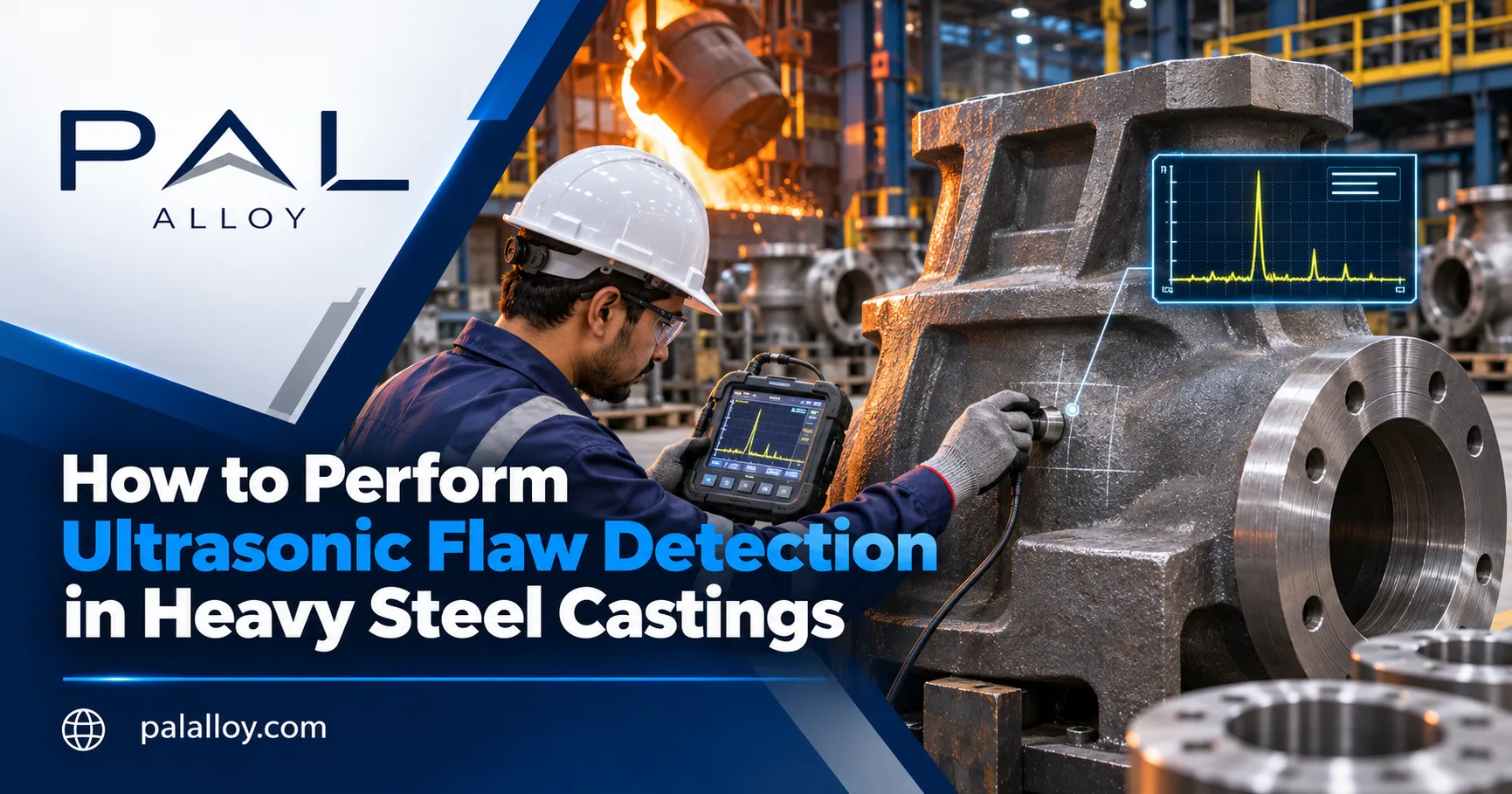
Ultrasonic Testing uses high-frequency sound waves to investigate internal discontinuities.
It may be required for heavy steel castings and other components where the geometry and material characteristics permit effective examination.
Magnetic Particle Testing (MT)
Magnetic Particle Testing is used to identify surface and near-surface discontinuities in ferromagnetic materials.
Liquid Penetrant Testing (PT)
Liquid Penetrant Testing is used to identify surface-breaking discontinuities in suitable non-porous materials.
How to Define NDT Requirements in an RFQ
A complete NDT specification should identify:
- Inspection method
- Applicable examination standard
- Inspection areas
- Percentage or extent of coverage
- Acceptance criteria
- Reporting requirements
- Inspection stage
- Third-party inspection requirements, if applicable
For example, instead of stating:
“NDT testing required”
A buyer could specify:
“Ultrasonic examination of the identified casting regions according to the applicable approved procedure, with examination coverage and acceptance criteria defined in the attached inspection specification.”
This gives the manufacturer a clearer technical requirement.
8. Share Mechanical Testing and Quality Documentation Requirements
Steel casting buyers may require specific material testing and inspection documents as part of the purchase order.
Common requirements include:
- Chemical composition reports
- Tensile test results
- Yield strength results
- Elongation results
- Impact test results, where required
- Hardness testing
- Heat-treatment records
- NDT reports
- Dimensional inspection reports
- Material Test Certificates (MTCs)
The RFQ should identify which documents are mandatory and whether customer or third-party witness inspection is required.
Heat Number and Traceability
Traceability helps connect a casting to its relevant manufacturing and testing records.
Depending on the contract, this may include:
- Casting identification
- Heat number
- Material grade
- Test results
- Inspection reports
- Production records
For critical industrial applications, traceability is an important part of quality assurance.
9. Mention Pattern and Tooling Requirements
Pattern development is a major part of the steel casting manufacturing process.
If the component is being manufactured for the first time, new tooling may be required.
When preparing the RFQ, clarify whether:
- Existing patterns are available
- New patterns need to be developed
- Core boxes are required
- Existing tooling requires modification
- Tooling is owned by the customer
- Tooling costs should be quoted separately
Why Tooling Information Matters
Pattern development costs depend on casting geometry, size, material, complexity, and the selected manufacturing process.
Complex components such as pump casings, valve bodies, and impellers may require specialized patterns and core arrangements.
Buyers should also clarify tooling ownership, maintenance, storage, and reuse arrangements when applicable.
10. Specify Order Quantity and Annual Requirements
Steel casting manufacturers need accurate quantity information to evaluate production and commercial feasibility.
Your RFQ should identify:
- Initial order quantity
- Prototype quantity
- Expected batch size
- Estimated annual demand
- Potential repeat orders
- Required delivery frequency
For example:
Initial Order: 10 pieces
Estimated Annual Requirement: 120 pieces
Delivery Schedule: Monthly batches of 10 pieces, subject to purchase order confirmation.
Different production volumes can influence tooling decisions, material procurement, setup costs, and unit pricing.
It is helpful to distinguish confirmed purchase quantities from estimated future requirements.
11. Include Surface Finishing and Protective Coating Requirements
The required surface condition may affect both manufacturing cost and delivery time.
Depending on the application, the RFQ may specify:
- Shot blasting
- Surface cleaning
- Grinding
- Fettling
- Surface finishing
- Protective coating
- Painting
- Rust-preventive treatment
- Preservation for storage or transport
The required finish should be suitable for the material, service conditions, and customer specification.
If certain surfaces must remain uncoated or require special protection, identify them clearly on the drawing or accompanying instructions.
12. Define Delivery Schedule and Commercial Requirements
A steel casting quotation should also include clear delivery and commercial expectations.
Important details include:
- Required quotation submission date
- Required production delivery date
- Delivery destination
- Packaging requirements
- Freight responsibilities
- Applicable delivery terms
- Inspection release requirements
- Payment terms
- Quotation validity
For international orders, buyers may also need to specify the applicable Incoterms rule and named delivery location.
The quotation should distinguish manufacturing lead time from transportation and delivery time.
Sample Steel Casting RFQ Format
The following example illustrates how buyers can organize a casting enquiry.
| RFQ Field | Example Requirement |
|---|---|
| Component Name | Industrial Pump Casing |
| Part Number | PC-250 |
| Drawing | PC-250 Rev. B |
| CAD Format | STEP and PDF |
| Material | ASTM A216 WCB |
| Estimated Weight | 250 kg |
| Quantity | 20 pieces |
| Delivery Condition | Fully machined |
| Heat Treatment | As specified by the applicable material standard |
| Machining | Flanges, mounting faces, and specified bores |
| NDT | As defined in attached Inspection and Test Plan |
| Dimensional Inspection | As per approved drawing |
| Quality Documents | MTC, NDT reports, dimensional inspection report |
| Tooling | New pattern required |
| Delivery Location | Customer’s designated facility |
| Delivery Schedule | To be agreed after technical review |
Note: The values above are illustrative and do not represent an actual customer order or approved manufacturing specification.
Common Mistakes to Avoid When Requesting a Steel Casting Quotation
Even experienced procurement teams can overlook information that affects casting prices and delivery schedules.
Sending Incomplete Drawings
Missing sections, unclear dimensions, or insufficient geometric details can prevent accurate technical evaluation.
Providing an Incorrect Material Grade
Using a general material description instead of a complete material specification may lead to incorrect quotation assumptions.
Ignoring Machining Requirements
A quotation for a raw casting cannot be directly compared with a quotation for a fully machined component.
Leaving NDT Requirements Undefined
Inspection requirements can significantly affect manufacturing cost and scheduling.
Not Mentioning Pattern Availability
Existing tooling may reduce development requirements, while new tooling can create additional costs.
Providing Unclear Quantities
A quotation for five pieces may differ substantially from pricing for recurring production batches.
Ignoring Documentation Requirements
Material certificates, third-party inspection, and detailed quality reports should be included in the original RFQ when required.
Comparing Only the Lowest Price
A low quotation may exclude machining, heat treatment, testing, tooling, or transportation.
Buyers should compare the complete technical and commercial scope rather than unit price alone.
How to Compare Quotations From Steel Casting Manufacturers
Once quotations are received, evaluate them against a consistent comparison framework.
| Evaluation Factor | What to Check |
|---|---|
| Material | Correct specification and grade |
| Drawing | Correct drawing revision |
| Manufacturing Scope | Raw, rough-machined, or finished casting |
| Tooling | Included or quoted separately |
| Heat Treatment | Included as required |
| NDT | Correct methods, coverage, and acceptance criteria |
| Machining | Required operations and tolerances included |
| Quality Documents | Required certificates and reports included |
| Lead Time | Production and delivery schedule |
| Logistics | Packaging, freight, and delivery responsibilities |
| Commercial Terms | Price validity, payment terms, and exclusions |
Any technical deviations or alternative material proposals should be identified and reviewed before purchase order approval.
This approach helps buyers distinguish genuinely competitive manufacturing quotations from offers based on incomplete or different scopes.
Steel Casting RFQ Checklist for Industrial Pump and Valve Components
Pump and valve castings often require additional technical details because of their geometry and service conditions.
For pump casings, valve bodies, bonnets, impellers, and similar components, buyers should consider providing:
- Applicable material grade
- Design pressure and temperature
- Fluid or chemical service conditions
- Critical wall thicknesses
- Internal passage geometry
- Flange dimensions
- Bore specifications
- Sealing surface requirements
- Machining tolerances
- NDT requirements
- Pressure-testing requirements, where applicable
- Material documentation
- Final delivery condition
These details help the manufacturer understand the component’s manufacturing and quality requirements.
How Pal Alloy Supports Custom Steel Casting Requirements
Pal Alloy manufactures steel and alloy castings for industrial pump, valve, and heavy engineering applications, supporting customers with drawing-based manufacturing requirements.
The company’s manufacturing capabilities include pattern development, steel casting production, CNC machining, material testing, and quality inspection.
Pal Alloy works with requirements involving:
- Carbon steel castings
- Alloy steel castings
- Stainless steel castings
- Industrial pump castings
- Valve body castings
- Heavy engineering castings
- RT-level castings
- CNC-machined cast components
- Custom OEM steel castings
When submitting a steel casting enquiry to Pal Alloy, buyers can share their technical drawings, material grades, required quantities, machining details, inspection requirements, and delivery expectations.
A clearly defined RFQ allows the manufacturing team to review the technical scope and prepare a quotation based on the stated requirements.
Conclusion
Preparing a complete steel casting RFQ checklist is one of the most effective ways to improve quotation accuracy and reduce misunderstandings during industrial casting procurement.
Engineering drawings, material grades, casting dimensions, machining requirements, inspection specifications, and delivery conditions all influence the manufacturing process and final cost.
By providing clear technical information at the quotation stage, buyers can compare suppliers more effectively, identify manufacturing constraints earlier, and reduce unexpected changes after purchase order approval.
For OEMs, procurement teams, and project engineers, a well-structured RFQ creates a stronger foundation for successful steel casting manufacturing.
Looking for a Reliable Steel Casting Manufacturer in India?
Pal Alloy supports industrial and OEM casting requirements through steel and alloy casting manufacturing, engineering support, machining, and quality-control capabilities.
Whether you require pump casings, valve bodies, stainless steel castings, alloy steel components, or customized heavy engineering castings, you can share your technical requirements with Pal Alloy for manufacturing review.
Frequently Asked Questions About Steel Casting RFQs
What should be included in a steel casting RFQ?
A steel casting RFQ should include engineering drawings, material grades, casting dimensions, quantity, machining requirements, heat treatment, inspection standards, documentation requirements, and delivery details.
Are 2D drawings enough for a steel casting quotation?
A complete 2D drawing may be sufficient for an initial quotation. However, 3D CAD models can improve technical evaluation, particularly for complex casting geometries.
Which drawing formats should I share with a steel casting manufacturer?
PDF drawings and STEP or IGES models are commonly useful. Native CAD files may also be supplied when compatible with the manufacturer’s engineering systems.
Why is the exact ASTM material grade important?
Different ASTM casting grades have different chemical compositions, mechanical properties, manufacturing requirements, and costs. Specifying the exact grade helps the manufacturer assess material availability and technical feasibility.
Should NDT requirements be included in the initial RFQ?
Yes. If radiographic, ultrasonic, magnetic particle, or liquid penetrant testing is required, the RFQ should define the examination scope and acceptance criteria before quotation.
What is the difference between a raw casting and a fully machined casting?
A raw casting is supplied after the agreed foundry cleaning and finishing operations, while a fully machined casting includes the specified machining necessary to achieve finished dimensions and tolerances.
Do I need to share a 3D model for heavy steel castings?
A 3D model is helpful but not always mandatory. It can assist with geometry evaluation, estimated weight, pattern development, and casting feasibility assessment.
How does order quantity affect steel casting pricing?
Order quantity influences tooling allocation, setup costs, material procurement, manufacturing planning, and production efficiency. Larger or recurring batches may offer different pricing compared with prototype quantities.
Can I request a quotation without knowing the casting weight?
Yes. If accurate drawings or a suitable 3D model are available, the manufacturer may be able to estimate the casting weight. However, the estimate should be verified during technical review.
How can I request a steel casting quotation from Pal Alloy?
You can contact Pal Alloy with your engineering drawings, material specifications, quantity requirements, machining details, inspection standards, and delivery expectations. The company can review the information to assess the manufacturing requirements.