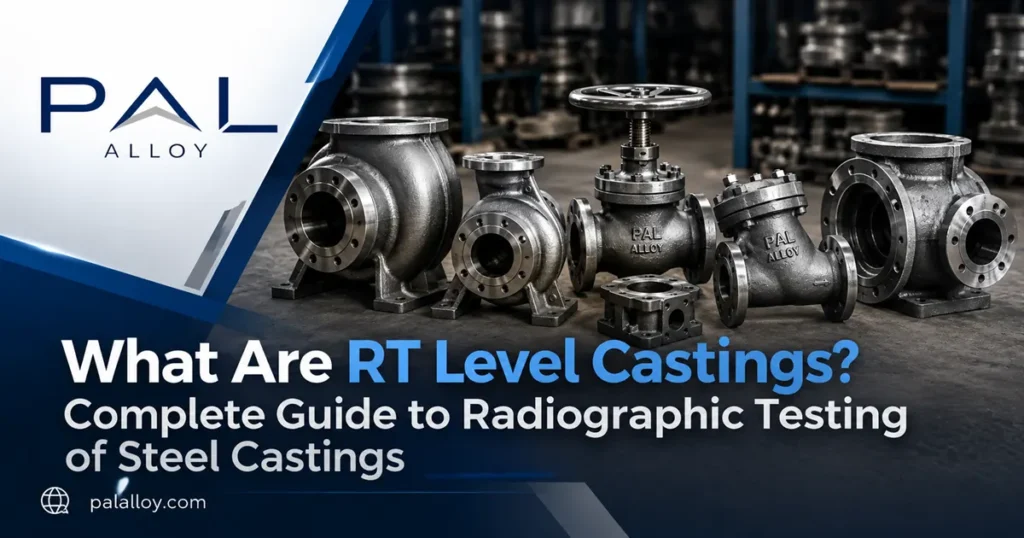
What Are RT Level Castings?
RT level castings are metal cast components that undergo Radiographic Testing (RT) to evaluate their internal integrity without damaging the component. The method uses X-rays or gamma radiation to create an image of the internal structure of a casting, helping inspectors identify discontinuities that may not be visible from the surface.
Radiographic testing is especially important for castings used in critical applications such as pumps, valves, pressure-containing equipment, oil and gas systems, power generation, chemical processing, and other industrial equipment where internal casting quality can directly influence reliability.
The American Society for Nondestructive Testing describes radiographic testing as a nondestructive examination method that uses X-rays or gamma rays to view the internal condition of a component. One of its major advantages is its ability to identify internal discontinuities while preserving a permanent inspection record.
At PAL Alloy, RT-level pump and valve castings are manufactured in carbon steel, alloy steel, stainless steel and other specified grades for industries including oil and gas, petrochemical, refining, power generation, water treatment, marine, mining and industrial OEM applications.
What Does “RT” Mean in Steel Castings?
In the casting industry, RT stands for Radiographic Testing.
The principle is similar to medical radiography. Radiation passes through the casting and is captured on film or another imaging medium. Differences in material thickness, density or internal discontinuities affect the amount of radiation reaching the detector, producing variations in the resulting image.
This allows qualified inspectors to study areas inside the casting that cannot be evaluated through visual examination alone.
ASTM E1030/E1030M provides a dedicated practice for radiographic examination of metallic castings and addresses methods for achieving practical radiographic coverage and detecting primarily volumetric discontinuities.
It is important, however, to understand an often-missed distinction:
Radiographic examination requirements and acceptance criteria are not necessarily the same thing.
A radiographic standard may define how the examination should be performed and how suitable images should be produced, while the actual acceptance or rejection criteria may be defined separately by the customer’s specification, applicable product standard, reference radiographs, engineering requirements or purchase contract.
ASTM’s guidance explicitly notes that radiographic examination standards are intended to control examination/image quality and do not by themselves establish acceptance criteria for every material or product.
This means buyers should clearly communicate the required RT specification and acceptance criteria when placing an order for critical castings.
Why Is Radiographic Testing Important for Steel Castings?
Casting is a complex manufacturing process. Molten metal must flow into the mould, solidify correctly and develop the required metallurgical and mechanical characteristics.
Even when the external surface of a casting looks acceptable, internal discontinuities can sometimes occur during solidification.
For components such as valve bodies or pump casings, internal integrity becomes particularly important because these components may operate under pressure, temperature variations, corrosive environments or continuous mechanical loading.
Radiographic testing provides manufacturers and customers with a way to assess internal areas without cutting or destroying the casting.
ASNT notes that RT is commonly used in manufacturing to inspect cast components for internal conditions such as voids, cracks and inclusions.
For critical components, RT therefore becomes an important part of an overall quality assurance system rather than simply another inspection step.
How Does Radiographic Testing of Castings Work?
The radiographic testing process begins with reviewing the drawing, material specification, component geometry and applicable inspection requirements.
The casting is positioned between a radiation source and the recording medium or detector. Depending on the procedure, X-rays or gamma rays pass through the casting.
Areas with different thicknesses or densities absorb radiation differently. The resulting radiographic image allows trained personnel to examine internal indications and compare them with the applicable inspection requirements.
Image quality is influenced by several factors, including source-to-component geometry, exposure conditions, material thickness, radiation energy, image quality indicators and the recording method.
ASTM E94/E94M covers industrial film radiography and emphasizes that consistent radiographic image quality depends on maintaining factors such as geometry, film, filtration and viewing conditions.
Complex casting geometry can also make complete radiographic coverage difficult. ASTM E1030/E1030M recognizes these practical limitations and notes that alternative methods or agreed examination approaches may sometimes be necessary when geometry prevents practical RT coverage.
What Defects Can Radiographic Testing Detect in Steel Castings?
Radiography is particularly useful for detecting internal or volumetric discontinuities.
Depending on the casting design, material, orientation of the discontinuity and inspection sensitivity, RT can help reveal conditions associated with porosity, shrinkage cavities, inclusions, voids and certain internal cracks or discontinuities.
The orientation of a defect matters. Radiography is highly effective for many volumetric imperfections, but very thin planar defects positioned unfavorably relative to the radiation beam can be more difficult to detect. ASNT therefore identifies discontinuity orientation and complex geometry among the limitations that must be considered when applying RT.
This is one reason why a comprehensive casting quality plan may use multiple NDT methods rather than relying on a single inspection technique.
RT Testing vs Other NDT Methods
Radiographic testing is only one part of nondestructive testing.
Visual Testing can identify visible surface conditions. Liquid Penetrant Testing can reveal surface-breaking discontinuities in suitable non-porous materials. Magnetic Particle Testing is useful for surface and near-surface discontinuities in ferromagnetic components. Ultrasonic Testing uses high-frequency sound waves and can also evaluate internal areas.
Radiographic Testing, meanwhile, is particularly valuable when an image of the internal structure is required.
ASNT classifies methods such as RT and UT as volumetric NDT techniques capable of detecting discontinuities within a material.
The appropriate combination should depend on the casting, material, specification, customer requirement and intended service conditions.
At PAL Alloy, the RT-level casting capability is supported by in-house machining along with NDT/DT testing, pattern development, engineering support and casting simulation capabilities.
Standards Commonly Associated With Radiographic Examination of Castings
Industrial radiographic examination should always follow the applicable customer specification, drawing, purchase order and relevant code or standard.
ASTM E94/E94M provides general guidance for radiographic examination using industrial radiographic film.
ASTM E1030/E1030M deals more specifically with radiographic examination of metallic castings and establishes a uniform approach to producing radiographic results with appropriate examination quality.
ASTM E1742/E1742M provides broader minimum requirements for radiographic examination of metallic and nonmetallic materials, including castings where specified.
The standard used does not automatically determine whether every indication is acceptable. Acceptance criteria should be confirmed against the product specification, customer requirements or other agreed reference criteria.
This point is particularly important when requesting an RT level casting quotation, because simply writing “RT required” may not provide enough technical information for the foundry.
RT Level Castings for Pumps and Valves
Pumps and valves frequently operate in environments where internal casting integrity is critical.
Typical valve casting components can include valve bodies, bonnets, covers, discs, wedges, gate/check-valve bodies, butterfly-valve bodies, ball-valve bodies, yokes, gland components, flanges and customized OEM castings.
Pump casting requirements may include pump casings, bodies, impellers, diffusers, bearing housings, suction covers, discharge covers, wear rings, pump brackets, casing covers, back plates and customized components.
PAL Alloy lists both pump and valve castings within its RT-level casting capability.
For such components, the required level of examination should be established according to application risk, pressure conditions, material, engineering requirements and customer specifications.
Materials Used for RT Level Castings
RT testing is an inspection method and is not limited to one specific steel grade.
PAL Alloy lists a range of material specifications for its RT-level pump and valve castings, including carbon, alloy and stainless steels.
| Material Category | Example Grades Listed by PAL Alloy |
|---|---|
| Carbon Steel | ASTM A216 WCB, WCC |
| Alloy Steel | ASTM A217 WC6, WC9, C5, C12A, CA15 |
| Stainless Steel | ASTM A351 CF8, CF8M, CF3, CF3M |
| Special Grades | ASTM A743, ASTM A744 |
| Other Materials | Cast Iron, SG Iron and equivalent grades |
Material selection should be based on operating temperature, corrosion environment, pressure, mechanical requirements and applicable engineering specifications.
For example, the material needed for a petrochemical valve operating under demanding temperature conditions may differ considerably from a casting intended for a water-treatment pump.
Therefore, material selection and RT acceptance requirements should be specified separately but considered together during casting development.
Industries Where RT Level Castings Are Used
RT-tested castings are particularly valuable in industries where failure of an internal component can lead to costly downtime, leakage, process interruption or safety concerns.
PAL Alloy supplies RT-level pump and valve castings for applications across oil and gas, petrochemical, chemical processing, refining, power generation, nuclear power, water treatment, marine and shipbuilding, mining, steel plants, fertilizer plants, pulp and paper, pharmaceuticals, food processing, EPC projects and industrial OEM sectors.
The exact examination requirement varies between industries and even between components within the same plant.
A general-purpose industrial casting and a pressure-critical valve body should not automatically be assumed to require the same RT procedure or acceptance criteria.
Benefits of RT Tested Steel Castings
Radiographic examination provides an additional level of visibility into the internal condition of a casting. It allows manufacturers and customers to evaluate internal areas while keeping the part intact.
The method also produces inspection records that can support traceability and quality documentation. ASNT identifies the ability to create a lasting inspection record as one of the benefits of radiographic testing.
For OEMs and industrial buyers, this can support greater confidence when sourcing components for demanding service conditions.
However, radiographic testing should never be viewed as a substitute for good foundry practice.
The objective should be:
Correct casting design → controlled melting and moulding → optimized solidification → heat treatment → machining → inspection → documented quality assurance.
RT verifies internal quality; it does not create quality after the casting has already been produced.
What Should Buyers Specify When Ordering RT Level Castings?
When requesting an RT-tested casting, buyers should provide enough technical information for the foundry and inspection team to understand both manufacturing and acceptance requirements.
Useful information generally includes the component drawing, material grade, quantity, machining condition, required areas of radiographic coverage, applicable RT procedure or standard, acceptance criteria, other required NDT methods, heat-treatment requirements, mechanical properties, dimensional tolerances and documentation requirements.
This is particularly important because radiographic coverage can be influenced by component geometry, and examination requirements may need agreement between the supplier and purchaser. ASTM E1030/E1030M explicitly recognizes this need where casting configurations make practical full coverage difficult.
A detailed RFQ therefore helps prevent technical assumptions and allows the foundry to plan the correct manufacturing and inspection route from the beginning.
How to Choose an RT Level Casting Manufacturer
Selecting a supplier for critical pump and valve castings requires more than checking whether the company can pour the required steel grade.
Buyers should evaluate the foundry’s casting engineering capabilities, process controls, quality assurance, material traceability, machining facilities, pattern development, NDT resources and experience with the required industries.
The manufacturer should also be capable of interpreting drawings and technical requirements before production starts.
PAL Alloy combines foundry and machining infrastructure with multiple international material grades, pressure-containing casting capabilities, custom OEM components, traceability, CNC machining, NDT/DT testing, pattern development and CAD/CAM and simulation support.
This integrated approach can be particularly valuable when the component requires casting, heat treatment, machining and inspection under one coordinated manufacturing process.
RT Level Castings at PAL Alloy
PAL Alloy manufactures RT Level Pumps & Valves Castings for critical industrial applications in carbon steel, alloy steel, stainless steel and special material grades.
The company’s casting portfolio includes customized OEM pump and valve components supported by advanced foundry infrastructure, machining, quality assurance, material traceability, NDT/DT testing and engineering support.
For customers requiring RT-tested castings, the appropriate manufacturing and inspection route can be developed according to the drawing, material specification, service conditions and applicable acceptance requirements.
Looking for RT-tested pump or valve castings for your next project? Share your drawings, required material grade, quantity and inspection specifications with the PAL Alloy team to discuss your casting requirements.
Conclusion
RT level castings play an important role wherever the internal integrity of a steel casting must be verified without destroying the component.
Radiographic testing gives manufacturers, OEMs and quality teams visibility into internal casting conditions and provides documented inspection evidence for critical components. But effective RT inspection begins long before the radiograph is produced—with appropriate material selection, sound foundry engineering, controlled manufacturing and clearly defined customer acceptance requirements.
For pumps, valves and pressure-containing components operating across oil and gas, petrochemical, power, water treatment, mining and other demanding industries, a properly planned RT inspection program can form an essential part of overall casting quality assurance.
For custom RT Level Pumps & Valves Castings, PAL Alloy offers multiple steel grades along with foundry production, CNC machining, NDT/DT testing, pattern development, traceability and engineering support.
Frequently Asked Questions
What is an RT level casting?
An RT level casting is a casting that has been subjected to specified radiographic testing requirements so its internal condition can be evaluated. The exact examination coverage and acceptance criteria depend on the applicable specification and customer requirements.
What does RT stand for in casting inspection?
RT stands for Radiographic Testing, a nondestructive testing technique that uses X-rays or gamma rays to create images of the internal structure of a component.
Can RT detect internal casting defects?
Yes. RT is commonly used to detect internal discontinuities such as voids, porosity, inclusions and other volumetric imperfections in cast components. Its effectiveness depends on factors including geometry, material thickness, defect size and defect orientation.
Is RT mandatory for every steel casting?
No. RT requirements depend on the component, application, code, drawing and customer specification. Many general-purpose castings may use different inspection plans, while pressure-containing or critical-service components may require more extensive examination.
Does passing radiography mean a casting is automatically acceptable?
Not by itself. The radiographic examination must be evaluated against the applicable acceptance criteria. ASTM radiographic practices govern aspects of examination and image quality but do not universally establish acceptance limits for every casting.
Which steel grades can PAL Alloy manufacture for RT level pump and valve castings?
PAL Alloy lists ASTM A216 WCB/WCC carbon steels, ASTM A217 alloy steel grades including WC6 and WC9, ASTM A351 stainless grades including CF8 and CF8M, special ASTM A743/A744 grades, and other materials or equivalents for its RT-level casting capability.