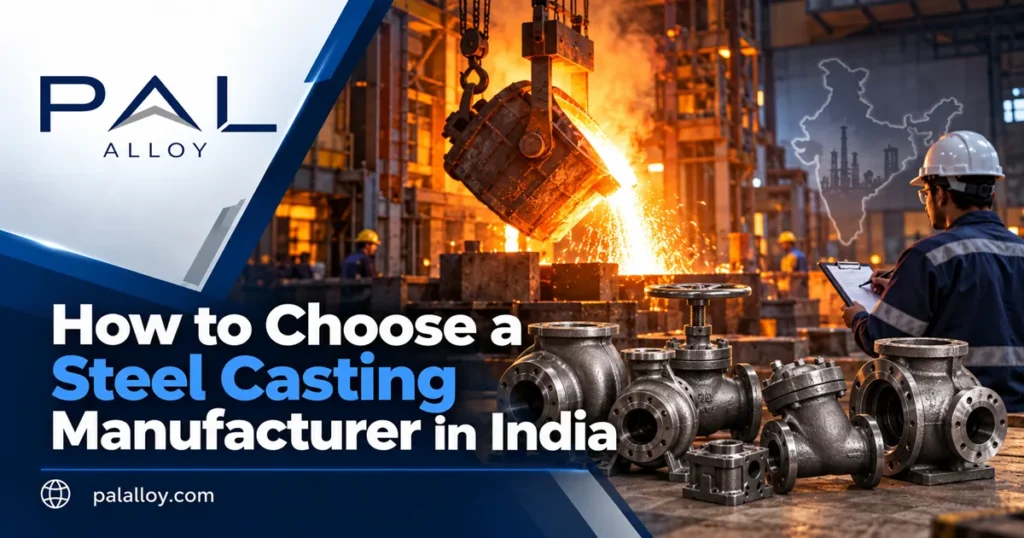
Choosing the right steel casting manufacturer in India is not simply a sourcing decision. The foundry you select can directly influence component life, equipment reliability, production downtime, procurement cost and ultimately the performance of your finished product.
India has a large and diverse casting industry supplying components to mining, cement, power generation, pumps and valves, automotive, heavy engineering, material handling, oil and gas and many other industries. That gives buyers significant choice—but it also makes supplier evaluation more important.
Two foundries may quote the same drawing at very different prices while offering completely different levels of material control, heat treatment, machining, inspection, traceability and engineering support.
Industry guidance from multiple casting manufacturers consistently emphasizes that buyers should look beyond price and evaluate factors including technical expertise, manufacturing infrastructure, material capability, quality systems, capacity, machining, certifications, logistics and long-term support.
This guide explains how OEMs, plant operators, engineering companies and procurement teams can systematically evaluate a steel casting foundry in India before placing an order.
Why Choosing the Right Steel Casting Manufacturer Matters
Steel castings are commonly used in applications involving:
- heavy mechanical loads
- abrasion and impact
- pressure
- high temperatures
- corrosion
- continuous operation
- complex geometries
- demanding dimensional requirements
Poor casting quality can result in premature wear, dimensional problems, machining difficulties, equipment failures, unplanned maintenance and production shutdowns.
For this reason, buyers should not evaluate a foundry only on:
Price per kilogram or price per casting.
A more useful evaluation considers:
Material + Manufacturing + Quality + Machining + Delivery + Reliability + Total Cost
Calmet similarly recommends assessing technical capabilities, quality systems, material expertise, machining, engineering assistance, production capacity and supply-chain reliability rather than selecting a supplier solely on price.
1. Start by Defining Your Casting Requirements
Before asking manufacturers for quotations, clearly define what the component actually requires.
A foundry cannot accurately evaluate a project if the RFQ only contains a photograph and approximate dimensions.
Where possible, provide:
- 2D engineering drawings
- 3D CAD files
- material grade
- casting weight
- finished component weight
- critical dimensions
- machining tolerances
- annual quantity
- batch quantity
- operating conditions
- heat-treatment requirements
- surface finish
- required NDT
- applicable standards
- documentation requirements
For components still under development, early engineering discussions with the manufacturer can identify potential issues involving wall thickness, machining allowance, pattern design, feeding and gating, or general casting manufacturability. Synergy Global similarly recommends giving potential suppliers drawings, CAD files, material specifications, production volumes and operating requirements before evaluating their suitability.
Important operating information may include:
Temperature
Will the casting operate under elevated or fluctuating temperatures?
Impact
Will it experience shock or repeated mechanical loading?
Abrasion
Will material continuously wear against the component?
Corrosion
Will it operate around chemicals, water or corrosive process media?
Pressure
Is it a pressure-containing pump or valve component?
The more clearly these conditions are understood, the better a competent foundry can evaluate material and manufacturing requirements.
2. Check the Manufacturer’s Material Expertise
Not every steel foundry has the same metallurgical experience.
A good alloy steel casting manufacturer should understand how different material grades perform under different operating conditions.
Depending on the application, casting materials may include:
- carbon steel
- alloy steel
- stainless steel
- high manganese steel
- high chrome materials
- wear-resistant alloys
- heat-resistant steels
- application-specific grades
Material selection affects:
- tensile strength
- hardness
- toughness
- impact resistance
- abrasion resistance
- corrosion resistance
- machinability
- heat-treatment response
- component life
Austin Alloy identifies material and alloy expertise as one of its key supplier-selection factors, particularly because different operating environments require different combinations of mechanical, thermal and corrosion properties.
What Should You Ask the Foundry?
Ask:
- Which steel grades do you manufacture regularly?
- Can you manufacture according to ASTM, IS, DIN, EN or BS specifications?
- How is chemical composition verified?
- Is each heat traceable?
- What mechanical tests are performed?
- Can custom alloy grades be developed?
PAL Alloy manufactures high manganese, high chrome and high-alloy steel castings and works with applicable Indian and international standards. Its published capabilities also include carbon steel, alloy steel and stainless steel grades across industrial casting categories.
3. Evaluate Foundry Infrastructure
A casting supplier’s website may say “advanced manufacturing,” but buyers should determine what infrastructure actually exists.
A serious industrial foundry should have appropriate capabilities across:
Pattern → Moulding → Melting → Heat Treatment → Fettling → Machining → Inspection
The equipment should also match the size and complexity of the castings you need.
Sigma’s foundry-selection guidance highlights production capacity, process technology, CAD/CAM, manufacturing equipment and scalability as important considerations when evaluating a casting manufacturer in India.
PAL Alloy’s Manufacturing Infrastructure
PAL Alloy operates dedicated pattern, moulding, melting, heat-treatment, fettling, machining and material-handling sections.
Its published infrastructure includes induction furnaces, controlled heat-treatment furnaces, CNC machining, horizontal boring, vertical turning and heavy-duty machining equipment.
The company states a manufacturing capacity of approximately 500 MT per month, with single castings up to approximately 3 MT, making capacity evaluation particularly relevant for buyers sourcing heavy industrial components.
4. Verify Melting and Chemical Control
The chemical composition of a steel casting directly influences its final properties.
A professional foundry should not simply rely on material input certificates. It should verify chemistry during production.
Ask whether the manufacturer has:
- optical emission spectrometry
- heat-wise chemical analysis
- temperature monitoring
- alloy verification
- heat-number identification
- documented chemistry records
PAL Alloy states that each heat is monitored for required chemical composition before pouring and that its laboratory uses optical emission spectrometry for alloy verification and heat-wise analysis.
Why Heat Traceability Matters
A good traceability chain should allow a casting to be linked back through:
Finished Casting → Heat Number → Melt → Material Analysis → Testing → Inspection Records
For critical industrial components, this can be significantly more valuable than a simple final inspection report.
5. Review the Manufacturer’s Quality Control System
Quality inspection should happen throughout production—not only after the casting is finished.
A strong steel casting manufacturer in India should have documented checkpoints at key manufacturing stages.
Synergy Global’s supplier-selection guide recommends evaluating incoming materials, melting controls, mould preparation, dimensional inspection, material verification, NDT, final inspection and corrective-action procedures.
A comprehensive process could include:
Raw Material Inspection
Verify incoming materials and alloy inputs.
Pattern Inspection
Check dimensions, surface condition and conformity with the drawing.
Moulding Inspection
Monitor sand properties, mould hardness, geometry and preparation.
Melting Control
Verify temperature and chemical composition.
Heat Treatment
Monitor furnace temperature, time cycles, quenching and tempering.
Machining Inspection
Verify critical tolerances, dimensions and surface finish.
Final Inspection
Confirm dimensions, identification, surface quality, documentation and customer requirements.
PAL Alloy publicly describes this type of stage-wise quality process from raw-material verification through final dispatch.
6. Check Testing and NDT Capabilities
Industrial buyers should confirm how the manufacturer verifies casting quality.
Depending on the component and specification, inspection may include:
- visual inspection
- dimensional inspection
- hardness testing
- tensile testing
- metallurgical examination
- ultrasonic testing
- magnetic particle inspection
- radiographic testing
Not every casting requires every inspection method.
The appropriate test should be determined by:
- material
- drawing
- specification
- service conditions
- safety requirements
- customer acceptance criteria
PAL Alloy Testing Capabilities
PAL Alloy lists in-house capabilities for:
Chemical Analysis
- Optical Emission Spectrometer
- heat-wise composition analysis
- alloy verification
Mechanical Testing
- tensile testing
- yield strength
- elongation
Hardness Testing
- multiple hardness-testing systems
Metallurgical Testing
- digital image analysis
- microstructure examination
- grain structure evaluation
NDT
- ultrasonic testing
- magnetic particle inspection
- visual inspection
Dimensional Inspection
- micrometers
- vernier calipers
- height gauges
- bore gauges.
The manufacturer also offers RT-level casting solutions for pressure-containing pump and valve components.
7. Evaluate Heat Treatment Capabilities
Heat treatment can significantly affect the final performance of a steel casting.
Depending on material and application, controlled heating and cooling may influence:
- hardness
- toughness
- ductility
- wear resistance
- mechanical strength
- microstructure
When evaluating a foundry, ask:
- Is heat treatment done in-house?
- What furnace sizes are available?
- Are temperatures continuously monitored?
- Are data loggers used?
- Can quenching be controlled?
- Are treatment cycles documented?
PAL Alloy operates multiple heat-treatment furnaces, including published capacities of 20 MT, 10 MT and 7 MT, with water quenching, digital temperature controllers, data loggers and thermocouples.
An in-house system can reduce dependence on external processors while giving the foundry greater control over the complete manufacturing sequence.
8. Look for In-House Machining
A casting is often only the first stage of the finished component.
Many OEM parts require:
- turning
- boring
- drilling
- milling
- CNC machining
- dimensional finishing
Using one supplier for casting and machining can reduce:
- transportation between vendors
- communication gaps
- dimensional mismatches
- procurement complexity
- overall lead time
Both Calmet and Austin Alloy identify integrated machining and value-added processing as advantages when evaluating casting suppliers.
PAL Alloy’s machine shop includes CNC vertical machining, horizontal boring, vertical turning lathes and heavy-duty lathes, allowing cast components to progress into machined components within the same manufacturing ecosystem.
9. Assess Engineering and Custom Development Support
A strong casting manufacturer should do more than reproduce a drawing.
Technical collaboration can help improve:
- casting feasibility
- material selection
- pattern design
- machining allowance
- gating and feeding strategy
- manufacturing consistency
- tooling
- component life
Austin Alloy emphasizes technical consultation and design-for-manufacturing support as important characteristics of a capable steel casting partner.
Synergy Global similarly recommends involving the manufacturer in design-for-manufacturability discussions where components are still under development.
Technologies to Look For
Modern foundries may use:
- CAD
- CAM
- casting simulation
- 3D scanning
- reverse engineering
- digital modelling
PAL Alloy states that its manufacturing infrastructure includes CAD/CAM simulation and modelling software and 3D scanning, alongside pattern development and engineering support.
This becomes particularly important for:
- customized OEM castings
- obsolete replacement components
- reverse-engineered spare parts
- complex geometries
- wear parts requiring material optimization
10. Check Production Capacity and Scalability
A supplier may be technically capable of producing your component but still be unsuitable if its available capacity cannot match your requirement.
Ask about:
- monthly casting capacity
- maximum single-piece weight
- melting capacity
- mould sizes
- heat-treatment capacity
- machining capacity
- normal lead time
- current workload
- peak production capability
Do not treat theoretical capacity as guaranteed available capacity.
Synergy’s OEM sourcing guidance recommends evaluating realistic capacity, lead times and the supplier’s ability to handle future production changes rather than relying only on maximum-capacity claims.
Why Scalability Matters
Suppose your initial requirement is:
25 components/month
but projected demand could reach:
100 components/month.
Changing foundries after tooling, trials and quality approvals can be expensive.
The supplier should therefore be evaluated for both:
Current Demand + Future Demand
11. Verify Certifications and Compliance
Certifications do not automatically guarantee a defect-free casting, but they indicate that a manufacturer has implemented recognized systems or has obtained relevant approvals.
Important credentials depend on the industry and product.
For example:
- ISO quality-management certification
- IBR approval for applicable boiler/pressure-related work
- customer-specific approvals
- product-specific qualifications
- third-party inspection acceptance
PAL Alloy states that it is ISO 9001:2015 certified and an IBR-approved foundry.
The company also states that it works to applicable standards including:
- IS
- ASTM
- DIN
- EN
- BS.
What Buyers Should Verify
Do not only ask:
“Are you ISO certified?”
Ask for:
- certificate copy
- issuing body
- validity
- certification scope
- plant/location covered
- applicable product approvals
This helps distinguish genuine relevant certification from credentials unrelated to your specific product.
12. Examine Experience in Your Industry
Experience manufacturing one type of casting does not automatically translate to another.
A manufacturer producing lightweight general engineering components may not have the same expertise as a foundry specializing in:
- mining wear parts
- cement mill components
- pressure-containing valves
- high-temperature power components
- abrasion-resistant steel parts
Calmet recommends checking a manufacturer’s years of experience, industries served, similar components, engineering capabilities and export experience.
PAL Alloy’s Application Areas
PAL Alloy supplies steel and alloy castings for industries including:
- mining
- cement
- power
- heavy engineering
- material handling
- steel plants
- pumps and valves
- oil and gas
- petrochemical
- water treatment
- industrial OEM applications.
For wear-intensive applications, its portfolio includes high manganese, high chrome and wear-resistant components such as liners, jaw plates, mantles, blow bars and mill parts.
13. Ask About Experience With OEM and Custom Castings
OEM sourcing often requires more than selecting a standard catalogue component.
The manufacturer may need to work from:
- customer drawings
- samples
- worn components
- 3D scans
- CAD models
- performance requirements
For custom castings, evaluate:
- pattern-development capability
- tooling ownership
- prototype process
- first-article approval
- revision control
- production traceability
Synergy recommends clarifying tooling responsibilities, ownership, maintenance, storage and modification arrangements before production begins.
PAL Alloy advertises custom pattern development, OEM-compatible components, reverse engineering and custom casting development across its industrial product categories.
14. Evaluate Delivery and Supply Chain Reliability
Even a technically excellent casting delivered several weeks late can create serious problems.
When evaluating a steel casting supplier, ask about:
- standard lead times
- production planning
- raw-material sourcing
- order tracking
- dispatch process
- packaging
- export capability
- urgent-order handling
- logistics partners
Both Austin Alloy and Calmet identify supply-chain resilience and logistics as important parts of choosing a manufacturing partner, especially for international buyers.
For overseas customers, also discuss:
- export packaging
- documentation
- shipping responsibilities
- Incoterms
- destination requirements
These issues should be agreed before production rather than after components are ready for dispatch.
15. Compare Total Cost, Not Just Casting Price
One of the most common sourcing mistakes is selecting a supplier based on the lowest quotation.
Assume:
Supplier A: ₹100/unit
Supplier B: ₹112/unit
Supplier A appears cheaper.
But suppose Supplier A also creates:
- higher rejection rates
- additional machining
- repeated inspection
- longer delivery times
- more frequent component replacement
The cheaper casting can easily become the more expensive component.
Sigma’s selection guide emphasizes balancing cost with manufacturing quality, while Synergy recommends evaluating tooling, machining, inspection, logistics, rework and rejection risk rather than comparing unit price alone.
Think in Terms of Total Cost of Ownership
Evaluate:
- Casting Price
- Tooling
- Machining
- Heat Treatment
- Testing
- Freight
- Inspection
- Rejection Risk
- Downtime Risk
- Replacement Frequency
The best supplier is the one offering the strongest overall business value—not necessarily the lowest casting rate.
16. Review Documentation and Traceability
For industrial castings, good documentation demonstrates that the manufacturing process is controlled and traceable.
Ask whether the manufacturer can provide applicable records such as:
- material test certificates
- chemical analysis
- mechanical test reports
- hardness results
- dimensional reports
- heat-treatment records
- NDT reports
- traceability information
- inspection certificates
PAL Alloy states that its production controls maintain traceability from raw-material identification and heat-number control through production monitoring, inspection documentation and dispatch verification.
This becomes especially important for critical castings and repeat orders.
17. Visit or Audit the Foundry Before Large Orders
Where the order value or operational risk is significant, a physical or third-party foundry audit can reveal far more than a brochure.
During the audit, evaluate:
- shop-floor organization
- material identification
- furnace condition
- moulding process
- heat-treatment control
- calibration status
- laboratory equipment
- pattern storage
- traceability
- NDT facilities
- machining area
- finished-goods handling
Also speak with:
- engineering
- quality
- production
- commercial teams
A technically strong supplier should be comfortable discussing its process in detail rather than relying only on marketing claims.
18. Request a Trial or Sample Order
Before committing to high-volume production, consider a prototype, development batch or trial order.
This allows both parties to validate:
- pattern
- casting quality
- material properties
- heat treatment
- dimensions
- machining
- inspection
- packaging
- documentation
A successful pilot also helps establish realistic production lead times and communication processes.
For complex OEM components, this step can significantly reduce risk before scaling production.
Steel Casting Manufacturer Evaluation Checklist
Use this checklist when comparing suppliers:
| Evaluation Factor | What to Check |
|---|---|
| Material Capability | Carbon, alloy, stainless, manganese, wear-resistant grades |
| Manufacturing | Pattern, moulding, melting and finishing capabilities |
| Capacity | Monthly output and maximum casting size |
| Heat Treatment | In-house furnaces and process monitoring |
| Quality Control | Stage-wise inspection and documented processes |
| Chemical Testing | Spectrometer and heat-wise analysis |
| Mechanical Testing | Tensile, yield, elongation and hardness |
| NDT | UT, MPI, RT or other required testing |
| Machining | CNC and heavy machining capabilities |
| Engineering | CAD/CAM, simulation, reverse engineering |
| Certifications | ISO, applicable approvals and standards |
| Traceability | Heat-to-finished-product identification |
| OEM Support | Pattern and customized casting development |
| Delivery | Production planning and logistics |
| Commercial | Transparent total cost |
| Support | Technical response and long-term service |
Questions to Ask a Steel Casting Manufacturer Before Ordering
Before finalizing your supplier, ask:
- Which steel grades do you manufacture regularly?
- What is your monthly production capacity?
- What is your maximum single-piece casting weight?
- Which industries do you currently supply?
- Can you manufacture according to our drawing and material specification?
- Is heat treatment performed in-house?
- What chemical-analysis equipment do you use?
- What mechanical testing is available?
- Which NDT methods can you provide?
- Do you offer CNC machining?
- Can you develop patterns and tooling?
- Do you use casting simulation?
- How is heat-number traceability maintained?
- Which quality certifications and approvals do you hold?
- Can you provide sample inspection reports?
- What is the normal lead time?
- How are rejection and corrective-action cases managed?
- Can production scale with future demand?
- Do you handle export orders?
- Can we audit your manufacturing facility?
The answers provide a much clearer picture than comparing quotations alone.
Red Flags When Selecting a Steel Casting Supplier
Be cautious if a supplier:
- quotes without reviewing drawings
- cannot clearly explain material grades
- has no heat-wise chemistry records
- cannot provide traceability
- outsources most critical processes without control
- cannot show testing equipment
- has no documented inspection procedure
- refuses manufacturing audits
- promises unrealistic lead times
- changes materials without approval
- cannot provide inspection documentation
- provides a dramatically lower price without explaining why
A reliable supplier should be able to explain how quality is created and verified, not simply claim that its products are high quality.
Why Choose a Steel Casting Manufacturer in India?
India has developed into a major sourcing destination for industrial castings because it combines:
- established engineering expertise
- skilled foundry manpower
- broad alloy manufacturing capability
- modern manufacturing infrastructure
- competitive production economics
- machining capabilities
- international export experience
However, “Made in India” alone does not guarantee quality.
The actual foundry must still be evaluated for process capability, material expertise, inspection, traceability and reliability.
That is why buyers should choose a manufacturer based on technical fit rather than geography or price alone.
Why Consider PAL Alloy as Your Steel Casting Manufacturing Partner?
PAL Alloy & Steel Casting (P) Ltd. is a steel casting manufacturer in India specializing in high manganese, high chrome, alloy steel and custom-engineered industrial castings.
Its manufacturing facility in Uttarakhand integrates:
- pattern development
- moulding
- induction melting
- heat treatment
- fettling
- CNC and heavy machining
- material testing
- metallurgical inspection
- NDT
- dimensional inspection.
The company reports approximately 500 MT monthly manufacturing capacity and the ability to manufacture single-piece castings weighing up to approximately 3 MT.
PAL Alloy also lists:
- ISO 9001:2015 certification
- IBR-approved foundry status
- manufacturing to applicable IS, ASTM, DIN, EN and BS standards
- complete material traceability
- in-house machining
- heat treatment
- chemical and mechanical testing
- NDT facilities
- CAD/CAM and casting simulation
- 3D scanning
- custom OEM casting development.
For pressure-containing applications, PAL Alloy also manufactures RT-level pump and valve castings in carbon steel, alloy steel and stainless steel grades including ASTM A216, A217 and A351 specifications.
Conclusion
Choosing the right steel casting manufacturer in India requires more than searching for the lowest price or the largest foundry.
The best manufacturing partner is one whose capabilities align with your actual application.
Before placing an order, evaluate:
- Material Expertise
- Foundry Infrastructure
- Melting Control
- Heat Treatment
- Quality Inspection
- NDT
- Machining
- Engineering Support
- Capacity
- Traceability
- Delivery
- Total Cost
For OEMs and industrial buyers, these factors can determine whether a casting becomes a reliable long-life component or a recurring maintenance problem.
A capable steel foundry should therefore function not merely as a component supplier, but as an engineering and manufacturing partner capable of understanding operating conditions, controlling metallurgy, maintaining traceability and consistently delivering components according to specification.
PAL Alloy combines alloy-steel casting, heat treatment, machining, testing, NDT and custom engineering capabilities under an integrated manufacturing setup in India, supporting industrial buyers across demanding sectors.
Looking for a steel casting manufacturer in India for custom industrial components?
Share your drawings, material specifications, required quantity, operating conditions and testing requirements with PAL Alloy to evaluate the most suitable manufacturing approach.
Frequently Asked Questions
How do I choose a steel casting manufacturer in India?
Evaluate the manufacturer’s material expertise, foundry infrastructure, production capacity, heat treatment, machining, testing facilities, quality system, certifications, traceability, industry experience and delivery performance. Compare total value rather than choosing only on the lowest quotation.
What certifications should a steel casting foundry have?
Certification requirements depend on the product and industry. ISO 9001 quality-management certification is commonly evaluated, while applications such as pressure equipment may require additional industry or customer-specific approvals.
Why is in-house machining important?
In-house machining allows a casting supplier to control dimensions beyond the as-cast stage and can reduce transportation, lead time and coordination between multiple vendors. It can also simplify responsibility for finished-component accuracy.
What NDT methods are used for steel castings?
Depending on the application, methods may include visual inspection, ultrasonic testing, magnetic particle inspection, liquid penetrant testing and radiographic testing. The required test should be defined by the specification and acceptance criteria.
How can I verify the material grade of a steel casting?
Material composition can be verified through chemical analysis such as optical emission spectrometry. Mechanical, hardness and metallurgical testing may also be required depending on the specification. Heat-number traceability should link the test results to the actual casting.
Should I choose the cheapest steel casting supplier?
Not necessarily. The lowest unit price can result in higher overall costs if it leads to excessive machining, high rejection rates, premature wear, delayed deliveries or equipment failures. Compare total lifecycle and procurement cost instead.
What information should I send when requesting a quotation?
Ideally provide drawings, material grade, quantity, component weight, critical dimensions, machining requirements, operating conditions, heat treatment, NDT requirements, applicable standards and required documentation.
Can PAL Alloy manufacture custom OEM steel castings?
PAL Alloy states that it provides custom casting development, pattern manufacturing, reverse engineering, machining and engineering support based on customer drawings and specifications.