Pump and valve castings often operate in demanding environments where pressure, temperature, corrosion, vibration, and continuous operation place significant stress on components. A casting may look completely sound from the outside while still containing internal discontinuities that cannot be identified through visual inspection alone.
This is why RT testing for pump and valve castings plays an important role in casting quality assurance.
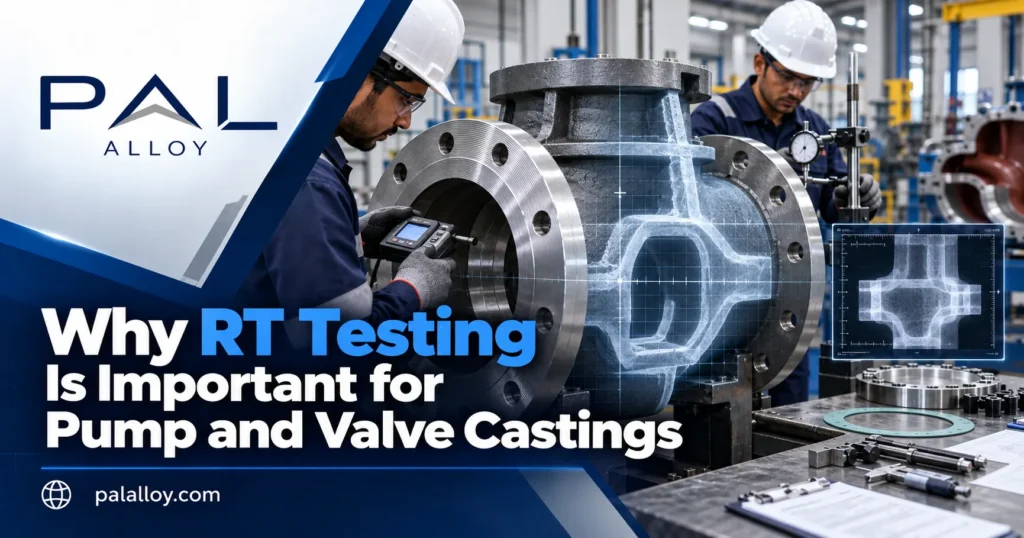
Radiographic Testing, commonly known as RT or X-ray testing, is a non-destructive testing method used to examine the internal structure of a casting without cutting or damaging the component. It can reveal internal discontinuities such as gas porosity, shrinkage, inclusions, blowholes, and certain cracks that may otherwise remain hidden.
For industries such as oil and gas, petrochemical, power generation, water treatment, mining, chemical processing, and industrial equipment manufacturing, verifying internal casting quality can be essential before a component enters service.
What Is RT Testing in Castings?
Radiographic Testing uses X-rays or gamma radiation to pass through a casting and produce an image of its internal structure.
Different areas of the casting absorb radiation differently depending on material thickness, density, and the presence of internal discontinuities. The resulting radiograph can then be examined by qualified NDT personnel to identify relevant indications.
RT is particularly valuable because many casting discontinuities are located below the surface and therefore cannot be reliably identified by visual inspection, Liquid Penetrant Testing (LPT), or Magnetic Particle Testing (MPT) alone.
For steel castings, ASTM publishes reference radiographs covering different casting thickness ranges, including ASTM E446, ASTM E186, and ASTM E280. The appropriate standard and acceptance criteria depend on the casting specification, thickness, application, customer requirement, and applicable code.
Why Is RT Testing Important for Pump and Valve Castings?
The main reason is simple: pump and valve castings frequently form part of a pressure-containing or performance-critical system.
A hidden internal discontinuity in a general-purpose casting may have limited consequences. The same type of discontinuity inside a pump casing, valve body, bonnet, impeller, or another pressure-related component can potentially affect structural integrity, service life, pressure containment, or operational reliability.
RT testing gives manufacturers and buyers additional information about the internal quality of the casting before it is placed into service.
1. Detects Internal Casting Discontinuities
Some casting imperfections are impossible to identify from the external surface.
RT can help reveal internal conditions including:
- Gas porosity
- Shrinkage and shrinkage porosity
- Blowholes
- Sand or slag inclusions
- Non-metallic inclusions
- Certain internal cracks
- Hot tears
- Internal cavities
The Steel Founders’ Society of America notes that internal discontinuities such as gas porosity, shrinkage porosity, and cracks may require methods such as radiographic or ultrasonic examination because they cannot necessarily be found through visual, liquid penetrant, or magnetic particle inspection.
Identifying these indications before machining, assembly, shipment, or installation can help prevent unsuitable castings from progressing further in the manufacturing process.
2. Important for Pressure-Containing Components
Valve bodies, pump casings, bonnets, covers, and similar components may be required to retain fluids operating under pressure.
Internal discontinuities located near:
- Flanges
- Nozzles
- Abrupt changes in section thickness
- High-stress regions
- Pressure boundaries
- Weld repair areas
- Critical junctions
can be particularly important from a quality standpoint.
Industry guidance for rotating equipment recognizes casting defects such as shrinkage, gas porosity, hot tears, sand inclusions, and cracks as conditions that may require nondestructive examination.
This makes RT testing for pump and valve castings particularly relevant when components are intended for severe or critical service.
3. Helps Reduce the Risk of Premature Component Failure
A pump or valve may operate for thousands of hours under pressure, temperature changes, vibration, fluid velocity, mechanical loads, and repeated operating cycles.
An internal discontinuity does not automatically mean that a casting will fail. Its importance depends on factors such as its type, size, location, severity, operating conditions, material, engineering design, and applicable acceptance criteria.
However, identifying and evaluating internal indications before service allows manufacturers and customers to make informed acceptance decisions rather than discovering a problem after installation.
This can contribute to improved reliability and more predictable component performance.
4. Supports Compliance With Customer and Project Specifications
Industrial buyers often define NDT requirements directly in:
- Purchase orders
- Approved Quality Plans
- Inspection and Test Plans (ITPs)
- Material specifications
- OEM standards
- Project specifications
- Applicable ASTM, ASME, API, or other industry requirements
RT requirements can include specified examination areas, examination extent, image quality, acceptance levels, reporting requirements, and personnel qualifications.
It is important to understand that a radiographic examination procedure and an acceptance standard are not necessarily the same thing. For example, ASTM E1742/E1742M provides requirements for performing radiographic examination but does not itself establish acceptance criteria for a component. Acceptance requirements must therefore be defined by the applicable specification, drawing, code, purchaser requirement, or engineering agreement.
For buyers, this is one reason to work with a casting manufacturer that understands both casting production and NDT documentation requirements.
5. Improves Quality Assurance Before Expensive Machining
Pump and valve components frequently require substantial secondary processing.
Depending on the component, this can involve:
- CNC machining
- Boring
- Drilling
- Milling
- Flange machining
- Heat treatment
- Welding or repair
- Pressure testing
- Surface finishing
- Final assembly
If an unacceptable internal discontinuity is discovered only after extensive machining, manufacturers may lose significant time, machining capacity, material, and production cost.
Performing the required RT examination at the appropriate stage of manufacturing can help identify potential problems earlier.
This can reduce unnecessary value addition to castings that may eventually be rejected.
6. Provides Documented Evidence of Internal Casting Quality
One of the major advantages of radiographic testing is the ability to create inspection records that can form part of the product quality documentation.
Depending on the agreed inspection requirements, documentation may include:
- Radiographic examination reports
- Identification and traceability information
- Exposure locations or RT maps
- Reference standard information
- Indication evaluation
- Acceptance status
- NDT personnel details
- Repair and re-examination records, where applicable
For OEMs and engineering companies sourcing castings for critical projects, traceability and inspection documentation can be nearly as important as the casting itself.
RT Testing vs Other NDT Methods for Pump and Valve Castings
RT is an important NDT method, but it is not the only inspection method used for castings.
Different NDT techniques identify different types of discontinuities.
| NDT Method | Primarily Used For | Typical Application |
|---|---|---|
| Visual Testing (VT) | Visible surface conditions | General surface inspection |
| Liquid Penetrant Testing (LPT/PT) | Surface-breaking discontinuities | Stainless steel and non-magnetic materials |
| Magnetic Particle Testing (MPT/MT) | Surface and near-surface discontinuities | Ferromagnetic castings |
| Ultrasonic Testing (UT) | Internal discontinuities | Thick sections and suitable casting geometries |
| Radiographic Testing (RT) | Internal volumetric discontinuities | Critical casting regions and pressure-containing castings |
RT and UT should not automatically be considered substitutes for each other.
Their suitability depends on casting geometry, material, thickness, discontinuity orientation, applicable specification, required examination coverage, and customer requirements.
A comprehensive casting quality plan may therefore use multiple NDT techniques.
Common Pump Castings Where RT Testing May Be Required
Depending on customer specifications and the criticality of the application, radiographic examination may be specified for components such as:
- Pump casings
- Pump bodies
- Impellers
- Diffusers
- Suction covers
- Discharge covers
- Bearing housings
- Casing covers
- Back plates
- Pump brackets
- Suction nozzles
- Adapter flanges
- Custom OEM pump castings
The extent of RT examination should always be determined by the applicable drawing, standard, engineering requirement, or customer-approved inspection plan.
Common Valve Castings Where RT Testing May Be Required
RT examination may also be specified for:
- Valve bodies
- Valve bonnets
- Valve covers
- Gate valve bodies
- Globe valve bodies
- Check valve bodies
- Butterfly valve bodies
- Ball valve bodies
- Valve discs
- Wedges
- Yokes
- Gland components
- Stuffing box components
- End covers
- Custom OEM valve castings
For critical applications, specific areas rather than the entire component may be designated for radiographic examination.
What Should Buyers Check When Ordering RT-Level Castings?
When sourcing RT-level pump or valve castings, price should not be the only purchasing consideration.
Buyers should evaluate the foundry’s complete manufacturing and quality capability.
Material Capability
Confirm that the manufacturer can produce the required material specification and grade.
Depending on application requirements, pump and valve castings may use carbon steel, alloy steel, stainless steel, or special alloy grades.
Defined RT Acceptance Criteria
Simply requesting an “RT tested casting” is not always sufficient.
The purchase specification should ideally define:
- Applicable RT procedure
- Examination coverage
- Casting areas to be examined
- Applicable reference radiographs
- Required acceptance or severity level
- Personnel qualification requirements
- Reporting requirements
- Repair requirements, where permitted
Clear requirements reduce misunderstandings between buyers, manufacturers, and third-party inspection agencies.
Manufacturing Capability
Internal casting quality begins during manufacturing not during inspection.
Buyers should consider a supplier’s capabilities in areas such as:
- Pattern development
- Casting process control
- Simulation and engineering
- Melting
- Moulding
- Heat treatment
- Machining
- Inspection
- NDT
- Material testing
- Quality traceability
RT should verify casting quality; it should not be treated as a replacement for good foundry practice.
Traceability
For critical castings, traceability should connect the manufactured component with relevant production and quality records.
Depending on contractual requirements, this may include material identification, heat numbers, inspection reports, test certificates, and NDT documentation.
RT Reference Standards for Steel Castings
Different reference radiographs may be applicable depending on section thickness and specification.
Common ASTM references include:
ASTM E446 – Reference radiographs for steel castings up to approximately 50.8 mm thickness.
ASTM E186 – Reference radiographs for steel castings approximately 50.8 mm to 114 mm thick.
ASTM E280 – Reference radiographs for heavy-walled steel castings approximately 114 mm to 305 mm thick.
The actual standard, severity level, and acceptance criteria should always be determined from the customer’s specification and applicable engineering requirements.
Why RT Testing Matters for Critical Industries
The importance of internal casting quality increases when pump and valve components are used in demanding industrial environments.
RT-level castings can be relevant for applications across:
- Oil and gas
- Petrochemical plants
- Chemical processing
- Refineries
- Power generation
- Water treatment
- Mining
- Steel plants
- Fertilizer plants
- Marine applications
- Pharmaceutical processing
- Industrial OEM equipment
- EPC projects
In these sectors, an unexpected pump or valve issue can lead to maintenance costs, production interruptions, replacement expenses, and project delays.
Quality assurance during casting manufacture therefore becomes part of overall equipment reliability.
RT-Level Pump and Valve Castings From Pal Alloy
Pal Alloy manufactures RT-level pump and valve castings for industrial and OEM applications, with capabilities across multiple steel and alloy grades.
Its pump and valve casting range includes components such as pump casings, impellers, diffusers, bearing housings, valve bodies, bonnets, covers, discs, wedges, and customized OEM castings.
Material capabilities listed by Pal Alloy include grades under:
- ASTM A216
- ASTM A217
- ASTM A351
- ASTM A743
- ASTM A744
- Cast Iron
- SG Iron
- Equivalent and customized material grades as applicable
Pal Alloy also highlights its foundry infrastructure, CNC machining capability, NDT/DT testing facilities, pattern development, CAD/CAM engineering, simulation support, quality assurance, and traceability for industrial castings.
For buyers, this combination helps create a more integrated manufacturing process from casting development through machining, testing, inspection, and final supply.
Choosing the Right RT-Level Casting Manufacturer
When selecting a supplier, look beyond whether a manufacturer simply offers radiographic testing.
A capable RT-level pump and valve casting manufacturer should be able to understand:
- Material specifications
- Casting geometry
- Pressure-containing requirements
- Critical examination areas
- NDT requirements
- Customer-specific acceptance criteria
- Machining allowances
- Testing documentation
- Traceability requirements
- OEM drawings and specifications
Close communication between engineering, foundry, machining, quality, and customer inspection teams can significantly improve project execution.
Conclusion
For pumps and valves used in demanding industrial applications, external appearance alone cannot confirm internal casting quality.
RT testing for pump and valve castings provides a non-destructive way to examine critical internal areas, identify relevant discontinuities, support quality documentation, and help manufacturers and buyers make more informed acceptance decisions.
However, successful RT-level casting production requires more than inspection. It starts with sound casting design, controlled foundry processes, appropriate materials, engineering expertise, machining capability, qualified inspection, and complete traceability.
If you are looking for RT-level pump and valve castings in carbon steel, alloy steel, stainless steel, or special grades, Pal Alloy can support OEM, industrial, replacement, and custom casting requirements.
Looking for RT-tested pump or valve castings for your next project? Contact Pal Alloy to discuss your drawings, material grade, NDT requirements, quantity, and technical specifications.
Frequently Asked Questions
What is RT testing for pump and valve castings?
RT testing is a non-destructive examination technique that uses X-rays or gamma radiation to inspect the internal structure of pump and valve castings. It can identify internal discontinuities such as porosity, shrinkage, inclusions, blowholes, and certain cracks without damaging the component.
Why is RT required for valve castings?
Valve castings can form part of pressure-containing systems. RT may therefore be specified to examine critical internal areas and verify that indications remain within the acceptance criteria required by the customer, project specification, or applicable standard.
Why is RT testing important for pump casings?
Pump casings can experience pressure, vibration, temperature changes, pipe loads, and continuous operating stresses. Radiographic examination helps identify internal casting discontinuities that may not be visible from the surface.
Can RT detect every type of casting defect?
No. Every NDT method has limitations. RT is particularly effective for many internal volumetric discontinuities, while PT, MT, UT, visual examination, and other techniques may be more suitable for different defect types or component conditions.
Is RT mandatory for every pump or valve casting?
No. RT requirements depend on the material specification, component design, service conditions, industry code, purchaser specification, and agreed quality plan. Some components may require complete examination, others may require examination only in critical areas, while some applications may not require RT.
Which ASTM standards are commonly associated with radiography of steel castings?
Reference radiographs commonly used for steel castings include ASTM E446, ASTM E186, and ASTM E280, with the applicable reference depending in part on casting thickness. The exact examination and acceptance requirements should be stated in the applicable purchase specification or quality plan.
What is an RT-level casting?
An RT-level casting generally refers to a casting manufactured and examined to meet specified radiographic acceptance requirements. Because different standards contain multiple severity or acceptance levels, buyers should specify the exact requirement rather than relying only on the term “RT level.”